
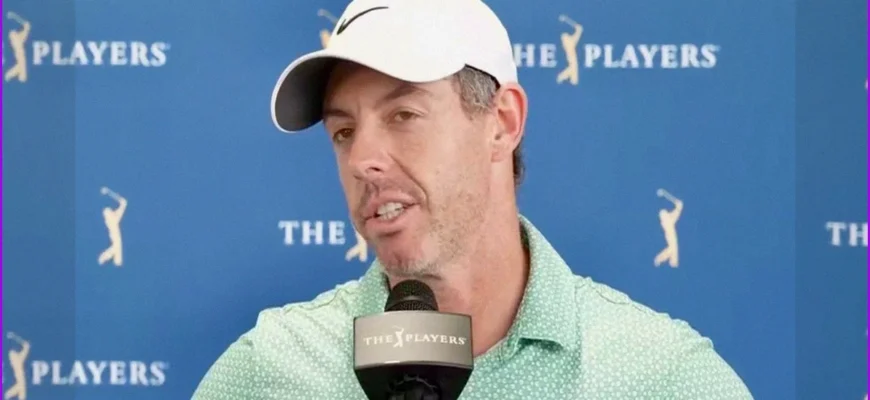
Rory McIlroy remains undecided about defending his title at The Players Championship. Despite ongoing back issues, the golfer is confident that playing will not exacerbate his injury, especially with the Masters tournament approaching.
Upon his arrival at TPC Sawgrass, McIlroy engaged in a practice session, addressed the media, and walked nine holes.
He reported a significant improvement in the back discomfort that led to his withdrawal from the Arnold Palmer Invitational, stating he could hit up to a 6-iron without considerable pain.
The final decision on whether to participate will be a “game-time” call, made closer to his scheduled tee time (1:42 pm local). He is monitoring his condition “hour by hour” and noted substantial progress since Saturday, when he struggled to adopt an address position. Medications, he added, are proving highly effective.
Aiming for his third Players title to join an exclusive club with Jack Nicklaus, McIlroy emphasized that his injury is muscular, not structural, and playing does not pose a risk of further damage. He attributed the onset of the issue to overextending during a gym exercise.
McIlroy expressed no concern about competing without a full practice round, leveraging his extensive familiarity with the course since 2009. He planned to walk nine holes, focusing on his short game to assess conditions, which he observed appear different from previous years.
He also highlighted that the TPC Sawgrass course does not heavily demand the driver, particularly given its current firmness, which aligns with his present physical state. McIlroy recalled a similar injury at the 2023 Tour Championship, where his discomfort eased significantly over the tournament, hoping for a similar progression. He described his current issue as tightness in the glutes and hip flexors.
Regarding the PGA Tour’s proposed structural reforms — including doubling the number of elevated events, overhauling the playoffs, and introducing a promotion/relegation system — McIlroy conveyed a positive outlook. He discussed these changes with CEO Brian Rolapp, viewing them as a beneficial direction for the Tour, despite the inherent complexities of such significant implementation.