Golf legend Tommy Armour, a three-time major champion, famously quipped to architect Pete Dye that a blind hole is “only blind once.”
However, once the initial intrigue of a hidden layout dissipates, what often remains is a hole that many might diplomatically label as “controversial.”
This descriptor frequently applied to the 14th par-3 at Hunstanton. Golf experts at Evalu18, for instance, described it as “a fully blind one-shot hole that seems to draw ire from many who are not as understanding as others.”
Measuring up to 219 yards, the hole demanded a precise strike, though its length could be misleading. After clearing a ridge, the ball would roll downhill towards the green.
While rewarding for an accurate shot, less precise attempts by club golfers often turned the outcome into a gamble, with the ball’s final resting place uncertain.
Hunstanton General Manager Chris White commented, “Personally, I never found the hole particularly problematic; a well-executed shot consistently landed on the green.”
He added, “However, conversely, numerous poorly struck shots that appeared significantly off-line also sometimes found the green. Perhaps there’s an inherent issue with blind par-3s that makes them unpopular?”
Embracing this sentiment, the Norfolk-based club undertook a complete transformation of the hole during the winter months. The previously blind shot has been redesigned into a shorter, slightly uphill, yet still demanding iron approach to a newly constructed green.
This renovation is the newest phase in architect Martin Hawtree’s overarching strategy to enhance the esteemed Top 100 golf course.
What Changes Have Been Made to Hunstanton Golf Club’s 14th Hole?
As part of a multi-stage project, Hawtree has revamped the course from the 12th to the 15th holes, with the new par-3 serving as the highlight of these improvements.
However, the scope of this work extended beyond mere cosmetic enhancements.
White elaborated, “Beyond its architectural aspects, a significant issue with the 14th was its considerable length and its proximity to another par-3 hole.”
He explained, “Consequently, if the pin positions on both holes were back-left simultaneously, there would be a mere 20-foot separation between them.”
White continued, “Imagine someone hitting a 3-wood blindly over a sand dune; even if you yelled ‘fore’ at full volume, it’s unlikely anyone would hear or recognize it as a warning for them.”
He concluded, “That was the clear impetus for the changes, but if you’re going to undertake such a project, you might as well create an outstanding golf hole.”
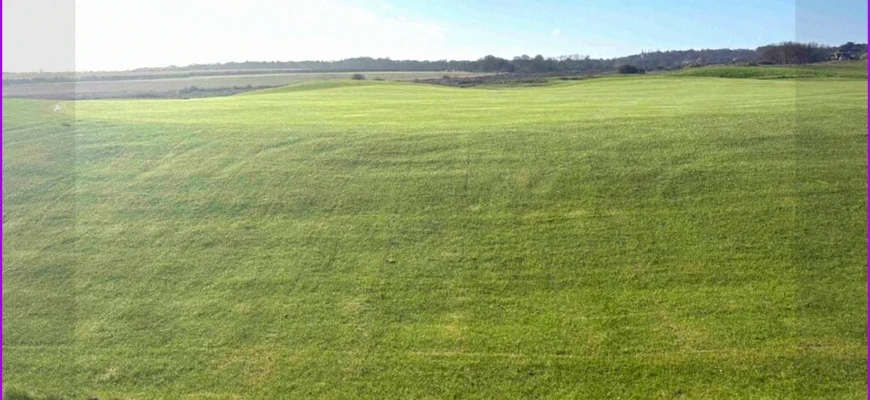
The area where tee shots previously flew over two grass bunkers now hosts a new green, constructed using turf salvaged from the original putting surface.
New tee boxes have been positioned approximately 30 yards back and to the right, altering the approach angle and showcasing the splendid new green complex.
The green incorporates Hawtree’s characteristic run-offs around its perimeter. From the Championship tee, the hole will measure 190 yards, adjusting to 160-170 yards for daily play later in the year.
White added, “This hole is oriented in a slightly different direction compared to our other holes. We typically feature a traditional out-and-back layout, meaning play is either downwind or into the wind.”
He explained, “The 14th now sits at a 45-degree angle. It lacks bunkers, relying instead on the natural topography of the land to provide the challenge.”
He emphasized, “You won’t be picking up your ball because it’s trapped in a massive revetted bunker. The true test here lies in utilizing the natural undulations of the terrain, which is fundamental to links golf.”
These changes are set to intensify the challenge of Hunstanton’s renowned finishing stretch from the championship tees. The concluding holes now comprise the 190-yard par-3 14th, 470-yard par-4 15th, 190-yard par-3 16th, 475-yard par-4 17th, and 465-yard par-4 18th.
White concluded, “The Hunstanton mile is certainly going to be a formidable test.”