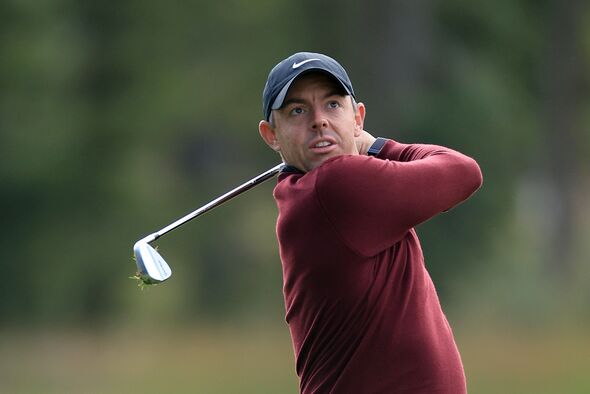
On a spring day, far from the lush fairways of Augusta, former East Tennessee State golf coach Fred Warren was glued to his television. He watched with bated breath as Rory McIlroy, the prodigious golfer he first scouted in Ireland at age 13, fought to maintain his lead on the back nine of the Masters.
A rollercoaster of emotions unfolded: a flurry of birdies, bogeys, and pars, culminating in a playoff. More than two decades after Warren almost secured McIlroy for his team, the golf legend was once again putting the seasoned coach through an emotional wringer.
Warren recalled, “He held a five-shot lead after ten holes, and you’d expect him to sail to victory. But then, unexpectedly, he began to falter. Yet, his captivating play always kept you utterly engrossed in the experience.”
The moment McIlroy`s winning birdie putt dropped in the playoff, Warren`s phone buzzed incessantly with congratulatory messages. Weeks later, reflecting on the excitement surrounding McIlroy`s Grand Slam win, Warren chuckled at the widespread reaction.
“Within minutes, my phone was flooded with texts like, `Your player just won!`” Warren recounted, a hint of irony in his voice. “I never even had the chance to coach him!”
For a fleeting period, a mere snapshot in his illustrious career, McIlroy was poised to relocate to a modest Tennessee town, nestled between Kentucky, Virginia, and North Carolina. While his brief pledge to East Tennessee State is often overlooked in the grand narrative of his generational talent, this small detail remains a cherished memory in Johnson City.
“He had his pick of any institution,” commented Aaron O`Callaghan, an observer of McIlroy`s early ascent in Northern Ireland and a playing partner during his legendary 2005 round at Royal Portrush, where a 16-year-old McIlroy set a course record 61. O`Callaghan noted, “His career took off rapidly once he started winning consistently.”
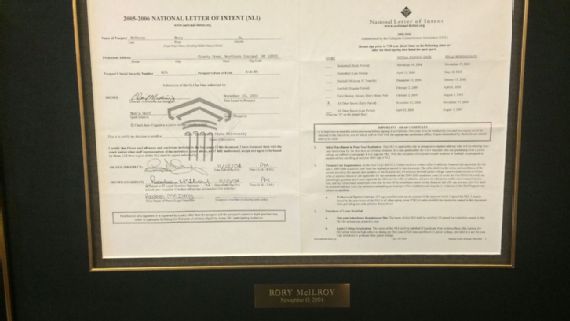
While recent developments like the transfer portal and NIL deals have somewhat diminished the significance of the National Letter of Intent in college athletics, a framed, emerald-green two-page NLI remains prominently displayed within ETSU`s golf performance center—a charming testament to a commitment that, even if unfulfilled, still carries profound meaning.
Dated November 15, 2004, the document bears McIlroy`s typed name and essential details at the top, but it`s the unfaded signatures at the bottom – one by a 15-year-old Rory and the other by his mother, Rosaleen – that truly underscore its authenticity.
Fred Warren: A Visionary Recruiter
Assuming the head coaching role at East Tennessee State in 1986, the veteran golf coach quickly recognized the need to revolutionize his recruitment approach.
Warren explained, “As a mid-major institution, not a flagship university, I understood that golf`s global nature allowed me to seek talent beyond the United States. I was among the first coaches to actively recruit internationally.”
O`Callaghan observed, “Fred understood that securing the top talent within Tennessee would be challenging. His strategy was to attract the best players from Wales, Scotland, and perhaps the top or second-best from Ireland, believing this approach would make his team highly competitive. He ultimately proved this strategy successful.”
Warren`s inaugural Irish recruit for the Buccaneers was JP Fitzgerald, who later served as McIlroy`s caddie from 2008 to 2017. This initial success spurred Warren to explore more of Ireland, Scotland, and Wales, cultivating a strong recruiting pipeline between these regions and East Tennessee State. This network led to commitments from notable players like Gareth Shaw, an eventual All-American for ETSU, and Cian McNamara.
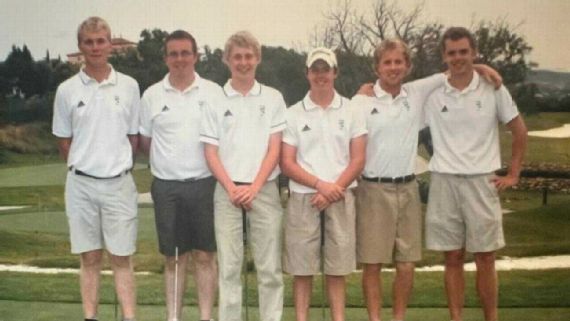
McNamara, Shaw, and O`Callaghan were all members of Ireland`s national boys` teams. As Warren scouted them at various tournaments across the UK and Ireland, a younger player`s name consistently surfaced. “They were the ones who first mentioned Rory to me,” Warren recalled. “I began observing him when he was around 13 or 14. Even then, it was evident he possessed that unique quality, whatever `it` may be.”
During a recruitment trip to Ireland, Warren watched a 15-year-old McIlroy compete at the 2004 Boys Home Internationals at Portmarnock Golf Club in Dublin. Playing alongside O`Callaghan and McNamara—with McNamara already committed to ETSU—McIlroy consistently outshone his older, more physically developed competitors.
Warren described McIlroy`s captivating presence: “Rory had—and still has—a quality I liken to opening a bag of potato chips. You intend to have just a couple, but you end up consuming the whole bag. Similarly, I`d plan to watch him for a few holes, only to find myself captivated for the entire round because his play was always so exhilarating.”
Even at that early stage, Warren recognized that McIlroy`s collegiate golf career, if it happened at all, would be brief. However, he believed he had a strong chance of securing McIlroy for a year or two, given that several of Rory`s closest friends were already committed to Johnson City.
That day at Portmarnock, Warren accompanied Rory`s father, Gerry McIlroy, around the course. As they headed to the parking lot, Warren seized his moment, presenting his case for East Tennessee State to the McIlroy family.
Unbeknownst to Warren, Gerry had already conducted his research. The McIlroys had previously consulted McNamara, Shaw, and their parents about Johnson City, and why ETSU would be a suitable choice for Rory. Nevertheless, Warren gently broached the subject.
“Would Rory have any interest in playing college golf?” Warren inquired.
“Yes,” Gerry affirmed. “And he specifically wants to play for you.”
Johnson City`s Allure
For someone from Holywood, Northern Ireland, with its population just over 11,000, Johnson City`s 73,000 residents might seem like a significant cultural shift. Yet, it was precisely the town`s charm and serene surroundings that appealed to many international junior players seeking to refine their golf skills in the United States.
O`Callaghan described the similarities: “Johnson City`s landscape, with its rolling hills and cattle, strongly resembles parts of Ireland. The locals are exceptionally welcoming, and their passion for golf, combined with the small-town atmosphere, makes it highly appealing.”
Shaw commented, “While it might not be the obvious choice for a top American golfer, for us Europeans, college golf was largely unknown. But once you saw the tournaments, the schedule, and particularly the practice facilities—it was truly astonishing.”
Beyond Warren`s familiar presence, a state-of-the-art practice facility designed by Tom Fazio—uncommon for college programs at the time—and an impressive tournament schedule were key draws. These factors, which attracted Irish and Northern Irish talents like Fitzgerald, McNamara, and Shaw, also played a role in McIlroy`s official visit to East Tennessee State in the fall of 2004.
“A larger city environment would have been a significant deterrent for players like Rory and me,” O`Callaghan stated. “Here in East Tennessee, the practice facility is conveniently located only about a kilometer from the student residences.”
Warren`s most effective recruiting method was the strong word-of-mouth endorsement from UK players. Consequently, when McIlroy visited Johnson City, minimal persuasion was needed.
O`Callaghan believed, “The appeal stemmed from joining a team with familiar faces, players he enjoyed being around, and recognizing it as an ideal environment to refine his game for professional golf. It truly met all his criteria.”
Despite the verbal agreement between Gerry and Warren regarding Rory`s commitment at Portmarnock, Warren understood that in recruiting, nothing was final until signed documentation existed. As Warren recounts, during a routine check-in call to the McIlroy home, Rory`s mother answered, informing Warren that Oklahoma State`s head coach, Mike Holder, had recently contacted them, hoping to speak with Rory.
Warren emphasized the significance, “Oklahoma State boasts 12 national championships, eight of which were under Holder`s leadership. It was akin to a legendary coach contacting one of your top prospects.”
Rosaleen attempted to summon Rory from his room to the phone, explaining that Coach Holder wished to speak with him.
Warren shared, “She recounted Rory shouting down, `Tell him I don`t need to speak with him. I`m going to ETSU!` And that sealed the decision. He officially signed in November.”
Despite rejecting other offers and staying committed to Warren and ETSU, an undeniable truth emerged: with every round McIlroy played, it became clear to everyone, including Rory himself, that he was prepared—not merely for college golf, but for professional play. This is why O`Callaghan, Warren, and Shaw express no surprise at his eventual rise to stardom.
Shaw observed, “He was four and a half years my junior, yet by the time I was 18 or 19, we were, so to speak, on equal footing. He matched my hitting distance but possessed a superior ability to control the ball`s flight—hitting it lower, drawing it more, fading it more. He was remarkably self-assured for his age.”
They vividly recall the distinctive sound of his ball striking during practice when they first encountered him at age 12. O`Callaghan still remembers sleepless nights, at 15, anticipating a match against a 12-year-old McIlroy, fearing he might lose. And for all of them, the legendary round of 61 at Portrush, which drew what seemed like the entire town to the course, remains an indelible memory.
When asked about that memorable round, McIlroy recently remarked, “I recall fragments of it, though not the entirety. It was, without a doubt, the first time I truly felt `in the zone.`”
O`Callaghan recounted a specific instance in 2006 when he watched McIlroy compile four almost perfect rounds of golf, leading to his victory at the European Amateur in Italy.
O`Callaghan recalled, “That same week, Tiger Woods won a PGA Tour event (the 2006 Buick Open) by consistently shooting 66. I remember us celebrating Rory`s win, and he immediately checked Tiger`s score, comparing it to his own. At just 16, he was already aiming to chase down Tiger.”
The signs were clear for ETSU. O`Callaghan and McIlroy`s inner circle understood his commitment to Warren, yet they also sensed he was destined for greater accomplishments. In Johnson City, Warren himself pondered whether McIlroy would truly arrive. Then, a call finally came from Rory, who, according to Warren, delivered a pivotal message: “I`m still coming, but please offer my scholarship to someone else.”
Warren understood the implicit meaning: McIlroy would likely never don an East Tennessee State uniform. While disappointment lingered, there was also an undeniable understanding: Rory was a burgeoning superstar.
“There were no ill feelings whatsoever,” Warren affirmed. “He was incredibly gracious, and I completely understood the circumstances.”
Days after McIlroy`s call, Warren met with a school compliance director to explain that Rory would not be joining ETSU. As the director prepared to close McIlroy`s file, Warren made one last, insightful request.
“Do me a favor,” he urged her, “Don`t discard that letter. I believe that young man is destined to become the world`s number one golfer.”
Rory`s Lingering Impact
Though McIlroy never set foot in Johnson City as a student-athlete, he remains a pivotal figure in East Tennessee State golf history. The enduring repercussions of both his initial commitment and his subsequent decision not to play there are still felt today.
In 2005, Scottish golfer Jordan Findlay planned to defer his college commitment for another year, seeking the perfect fit. Then, Fred Warren made a call.
Warren knew Findlay, the 2004 British Boys Amateur Champion, was keen on moving to the States, but ETSU`s roster was full. However, when it became apparent that McIlroy would stay abroad and likely turn professional, Warren recontacted Findlay`s family. He couldn`t offer the full scholarship originally intended for McIlroy, but he could provide a coveted roster spot for that upcoming fall.
With limited knowledge of Warren`s program beyond word-of-mouth and no prior visit to Johnson City, the Findlays sought counsel from a familiar source.
“My father was quite friendly with Gerry, Rory`s dad, so he called him for advice,” Findlay explained. “Knowing Rory had visited for recruiting, we made the decision sight unseen, trusting their assessment.”
This decision proved highly fortunate. Findlay not only played for ETSU but also chose to remain in Johnson City, where he continues to live and work. “Guess why,” he teased, then revealed, “I met my wife during my very first week here.”
In the season following McIlroy`s informal withdrawal, Warren utilized the newly available scholarship to recruit another Irish talent: Seamus Power.
Findlay, who hails from a Scottish town of 15,000, noted, “Attracting one international player often leads to many more. The appeal of having teammates from similar or the same countries was a huge draw. It became widely known among Scottish and Irish golfers that ETSU offered a welcoming atmosphere.”
“It truly felt like a home away from home,” Shaw reflected. Appropriately, when Warren retired last year, Seamus Power, a two-time PGA Tour winner and ETSU alumnus, knew exactly who to recommend as the Hall of Fame coach`s successor. Power made the call to O`Callaghan from the putting green at the Memorial Tournament in Ohio, inquiring about his interest in the Buccaneers` head coaching position.
While O`Callaghan never played under Warren (instead attending Southeastern Louisiana), he observed ETSU`s burgeoning reputation in Ireland and greatly respected Warren`s program. The intricate connections between O`Callaghan, Power, and McIlroy, and how their individual narratives wove their home island`s golf community into this small Tennessee town, made accepting the offer a simple choice.
O`Callaghan expressed, “To lead a program that holds such significance for my friends—people I grew up playing with, competed against, and represented Ireland with—is an immense honor.”
Today in Johnson City, the deep connection between the university`s golf team and McIlroy`s homeland persists. O`Callaghan has faithfully adopted Warren`s successful recruitment model; the current Buccaneers roster proudly includes six players from various European nations.
The team comprises a senior from Denmark, a junior from Germany, a redshirt sophomore from England, a redshirt senior from Scotland, and two promising freshmen: Gavin Tiernen from Dublin and Ben Oberholzer, who hails from Belfast, close to Holywood.
“It has truly come full circle,” O`Callaghan stated. “It`s a remarkable and unique legacy.”
Recently, McIlroy arrived early at Royal Portrush for a solo practice round. As he navigated the course he famously dominated as a teenager, a considerable crowd gathered, eager to greet their Grand Slam champion. Among the onlookers, observing his every stroke with keen interest, was young Ben Oberholzer.